
banner

Mains Test Series: Think, Structure, Articulate

Our Mains Test Series focuses on developing the three pillars of answer writing — structure, substance, and style.

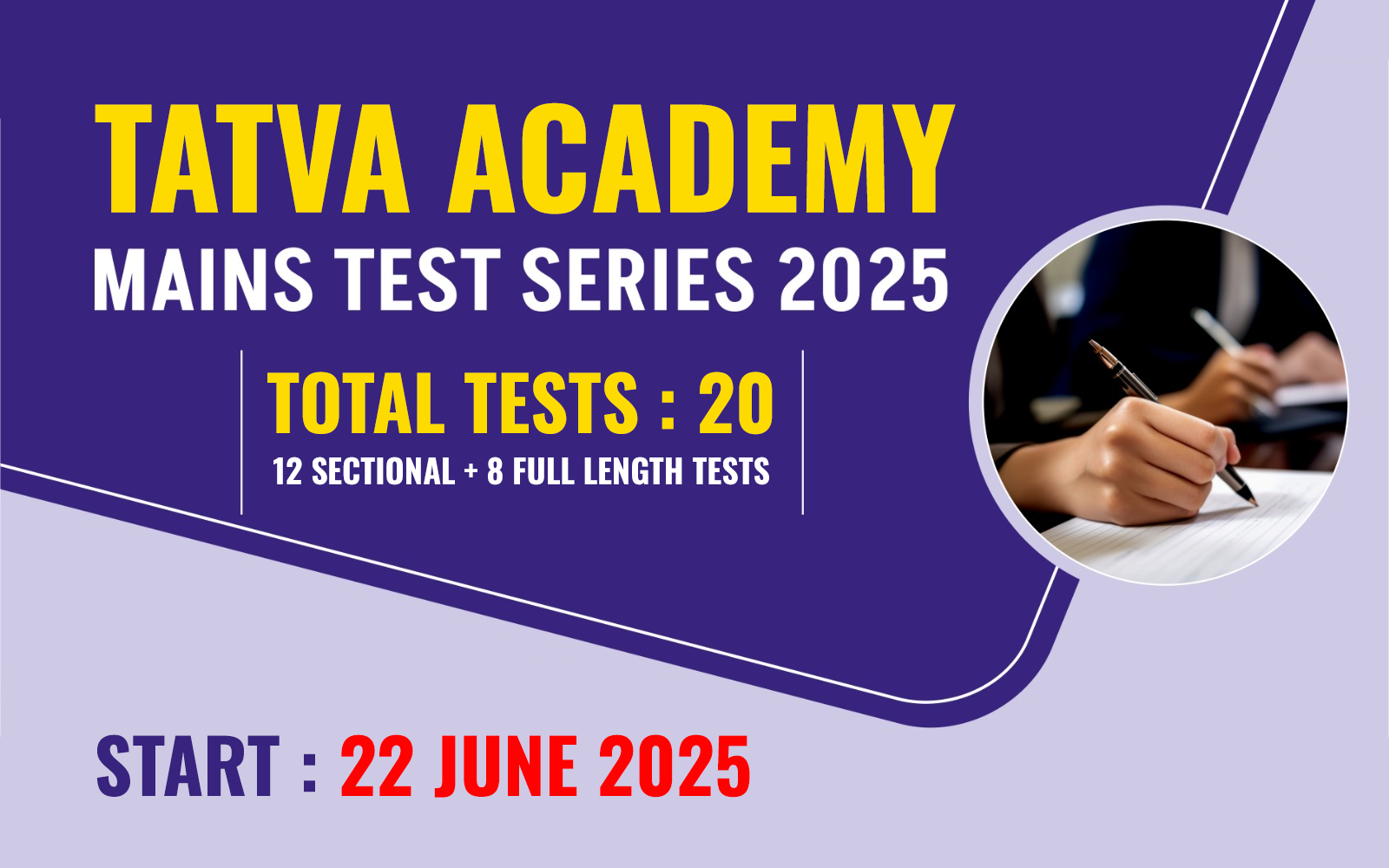
  • 12 Sectional + 8 Full-Length Tests: Covering GS 1, 2, 3, 4, Essay, and Optional (Optional Test Series launched separately).
  • Detailed Model Answers and Line-by-Line Evaluations with individual feedback.
  • 1:1 Mentorship on Writing Improvement: — grammar, structuring, flow, analysis, interlinkages.
  • Peer Discussions + Faculty-Led Strategy Sessions after each test.

We believe Mains is not just about knowledge — it’s about expression, balance, and strategic articulation under pressure. Our test series reflects the actual UPSC constraints of time, word limit, and unpredictability.
Mains Test Series
Phase I – Subject-Wise Basic Tests (Foundational Clarity)

The UPSC Civil Services Mains Examination is not merely a test of knowledge — it is an assessment of perspective, articulation, and intellectual clarity. At Tatva academy of Civil services, our Mains Test Series is meticulously designed to help aspirants transition from learners to thinkers, from note-makers to answer-writers.

Whether you're appearing for the first time or are a seasoned aspirant seeking to improve your ranks, our test series will train you to write structured, analytical, and high-impact answers under exam constraints.

rating

Objectives of Our Mains Test Series:

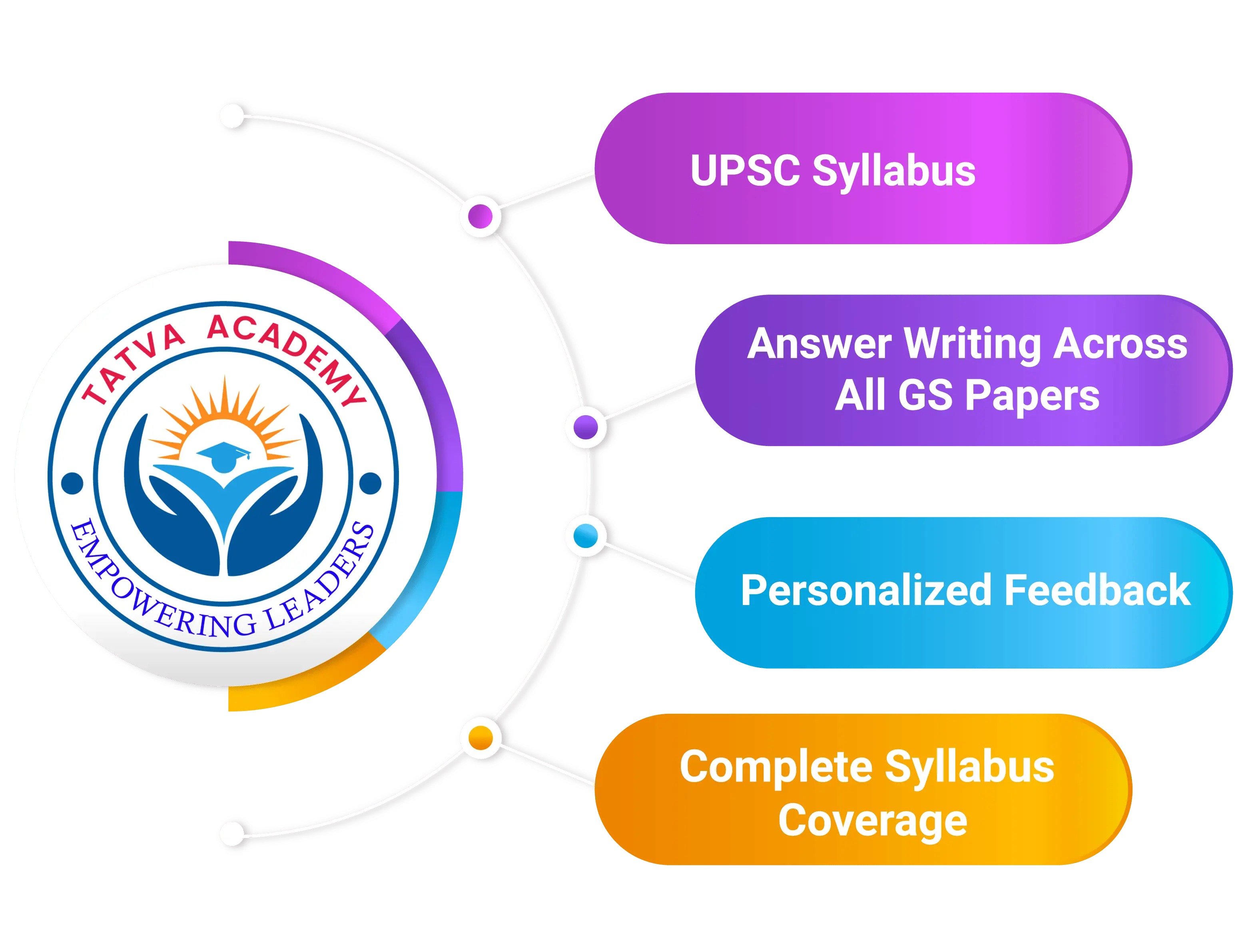
  • To synchronize your preparation with the UPSC syllabus and previous-year trends.
  • To build consistency and speed in answer writing across all GS papers, Essays, and Ethics.
  • To provide personalized feedback that focuses not only on what to write but how to write better.
  • To simulate UPSC-level pressure through timed, evaluative, and competitive test settings
  • To ensure complete syllabus coverage and identify individual strengths and weaknesses through analytics.
image

Key Features

1. 20 Tests Total (12 Sectional + 8 Full-Length):

  • GS Paper 1–4: Comprehensive coverage.
  • GS Paper 1–4: Comprehensive coverage.
  • Essay Paper: Idea generation, structuring, and philosophical writing

2. Detailed Evaluations within 5–7 Days:

  • Every answer is evaluated with attention to content, structure, innovation, interlinkages, and conclusion quality.
  • Feedback is precise, constructive, and includes model introductions, value additions, and expected keywords.

3. 1-on-1 Mentorship:

  • oPost-evaluation sessions with senior mentors to discuss scripts, identify weaknesses, and build a personalized strategy.

4. Model Answers & Peer Comparisons:

  • Learn not only from your feedback but also from the best-written answers in your cohort.

5. In-Class Writing Workshops

  • Focused modules on how to frame introductions, use data, integrate current affairs, and conclude effectively.
  • Use of diagrams, flowcharts, and mnemonics taught and practiced.

6. Ethics Enhancement Workshops:

  • Case study solving frameworks, moral reasoning techniques, and answer templates.
  • Emphasis on originality and balance in ethical dilemmas.

7. Essay Writing Mastery:

  • Four dedicated Essay tests with thematic and philosophical topics.
  • Ideation sessions, quotations database, and structure building.
banner
banner

Mains Test Series Schedule (Structured, Flexible, Intensive)

Mains Test Series Schedule (Structured, Flexible, Intensive)
Test No Paper Topics Covered (Representative Themes)
1 GS Paper I Indian History + Art & Culture (Ancient to Post-Independence)
2 GS Paper I Geography + Society + Role of Women
3 GS Paper II Constitution, Federalism, Parliament, Judiciary
4 GS Paper II Governance, Welfare Schemes, International Relations
5 GS Paper III Economy, Agriculture, Budgeting
6 GS Paper III Environment, Disaster Management, Science & Tech
7 GS Paper IV Ethics Theory + Thinkers + Integrity & Aptitude
8 GS Paper IV Case Studies (10 full-length case studies)
9 Essay Paper I Philosophical and Abstract Topics
10 Essay Paper II Socio-political, Economic, and Technological Themes
11 Optional Paper I (if opted) Subject-specific topical focus tests
12 Optional Paper II (if opted) Continued advanced paper structure
Phase II – Full-Length Simulated Tests (Weeks 9–12)
Test No Paper Format Focus Area
13 GS Paper I Full-length 250 marks Complete paper simulation
14 GS Paper II Full-length 250 marks Includes Current Affairs and Governance
15 GS Paper III Full-length 250 marks Economy, S&T, Security
16 GS Paper IV Full-length 250 marks Ethics + 4–5 case studies
17 Essay Paper Full-length 250 marks 2 Essays in 3 hours
18 GS Paper I–IV 4-Paper Back-to-Back Simulation Conducted like real UPSC schedule
19 Optional Paper I Full-Length Final run-through with subject expert feedback
20 Optional Paper II Full-Length Model answers + time management

Mains Booklist (General Studies I–IV + Essay)

Paper Topics Recommended Books
GS Paper I History, Culture, Geography, Society Same as Prelims + Themes in Indian History (NCERT XI–XII) Social Problems in India by Ram Ahuja World History: Norman Lowe (selective); Oxford Atlas (for maps)
GS Paper II Polity, Governance, IR M. Laxmikanth; Introduction to the Constitution by DD Basu (selective); IGNOU Notes on Governance Current Affairs-based Notes India’s Foreign Policy by Rajiv Sikri (selective)
GS Paper III Economy, Science & Tech, Environment, Security Ramesh Singh for Economy; Economic Survey & Budget Summary Shankar IAS Environment Challenges to Internal Security by Ashok Kumar Vision/Forum S&T Handouts
GS Paper IV Ethics, Integrity, Aptitude Lexicon for Ethics; Subba Rao Ethics Second ARC Reports (selective) Case Study Compilations (Vision/Forum)
Essay Paper Essay Lexicon Essay Book; Selected Essays by Saeed/UPSC Toppers’ Essay Booklets
Optional Subject (e.g., PSIR, Anthropology) Subject-specific standard books & notes (tailored list on request)